I have some projects that I want to write about here. Check back later when I've had more time to get my site organized.
In Nebraska, and probably other states, the process for installing judges of the high courts involves a nomination committee drafting a list of acceptable judges and the governor selecting one to fill the position. Because these judges serve the public, there must be some avenue for the residents of the state to decide if they are happy with the appointment made by the governor. The first election that happens 3 years after they have been installed a retention vote is held on the state election ballot. Following that initial vote, additional retention votes happen every 6 years. But who in the public is to say whether these justices should be retained?
Enter the Nebraska State Bar's Judicial Evaluation Poll results. The state surveys attorneys who interact the judges on a regular basis and asks them to score them on a variety of aspects of the way they conduct business. They also ask whether the judge should be retained or not. Each year, the bar brags about how many of the judges score above 50% of the attorneys voting they should be retained in office. But should 50% be our threshold for an "acceptable" judge? Shouldn't we be closer to 100%? Each year, the results of this survey are published in PDF form so that the public can make this decision for themselves. I don't find the PDF format to be particularly useful for making these sorts of decisions. I'd like to see the history of the votes that the judge has received, to see if they are improving over time, or maybe sliding into complacency. I sent an email to Sam Clinch asking if I could have the raw data rather than the PDFs so that I could more easily make some plots of the data.
He denied my request.
I decided to take it upon myself to convert the data to a more parseable format to make it easier to compare judges. A little under 2 years later, I've converted the data back to 2016 into digital form. I hoped and planned to make a really cool interactive website where an interested voter could type in the name of a judge on their ballot and immediately see how they scored in the judicial review and how they compared to other judges. It's now time for me to accept that given my current skills this isn't possible. If anyone has the skills to make such a website, I encourage you to do so. I would happily parse the remaining data which goes back to 2002, if someone else could make the slick website to visualize it.
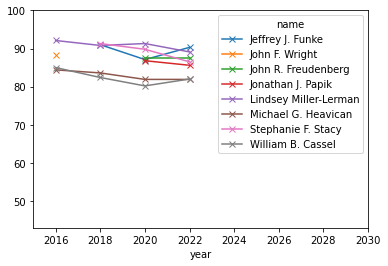
For now, I'll leave you with the .csv file containing the data from the 2016, 2018, 2020, and 2022 reviews and a single image showing the retention votes for the supreme court judges which sat over that period.
For now, I'll leave you with the .csv file containing the data from the 2016, 2018, 2020, and 2022 reviews and a single image showing the retention votes for the supreme court judges which sat over that period.
Levi's 511 - Slim Fit, 32W x 36L
Comments: Tighter than I like on the legs when first trying on, they feel like they'll restrict motion. They seem like they'll loosen just enough as they age to be really comfortable.
Whenever an event needs an extra spark of joy, I recommend making a recipe for giant bubbles. I share here a few recipes I've found. I find Recipe 1 the most approachable because all of the ingredients can be found at a modestly sized grocery store. Anecdotally, recipe 2 produces the best results, but requires several specialized ingredients that can be difficult to procure. If you'd like a small quantity of J-Lube, let me know, and I can probably hook you up.
A word of warning: these mixtures contain lubricants and soap, and the residue left behind after your bubble fun can make things very slippery. Take caution and try to limit the reside to locations where there will not be heavy traffic.
Justin Burton recommends the following recipe for blowing giant soap bubbles. He cautions, however, that factors that cannot be controlled outside of a laboratory, such as humidty levels, may alter the results.
From: https://news.emory.edu/features/2020/01/physics-of-bubbles/index.html
This recipe produced the largest bubbles I have personally witnessed to date, but when I tried to reproduce the recipe the bubbles were still large but not as big as the first time I saw them. Perhaps it was because I lacked the Pot & Pan Dawn dish soap.
Sometimes, you don't have some of the ingredients that are called for in the recipe. The following was a variation on recipe 2 that still produced usable bubbles.